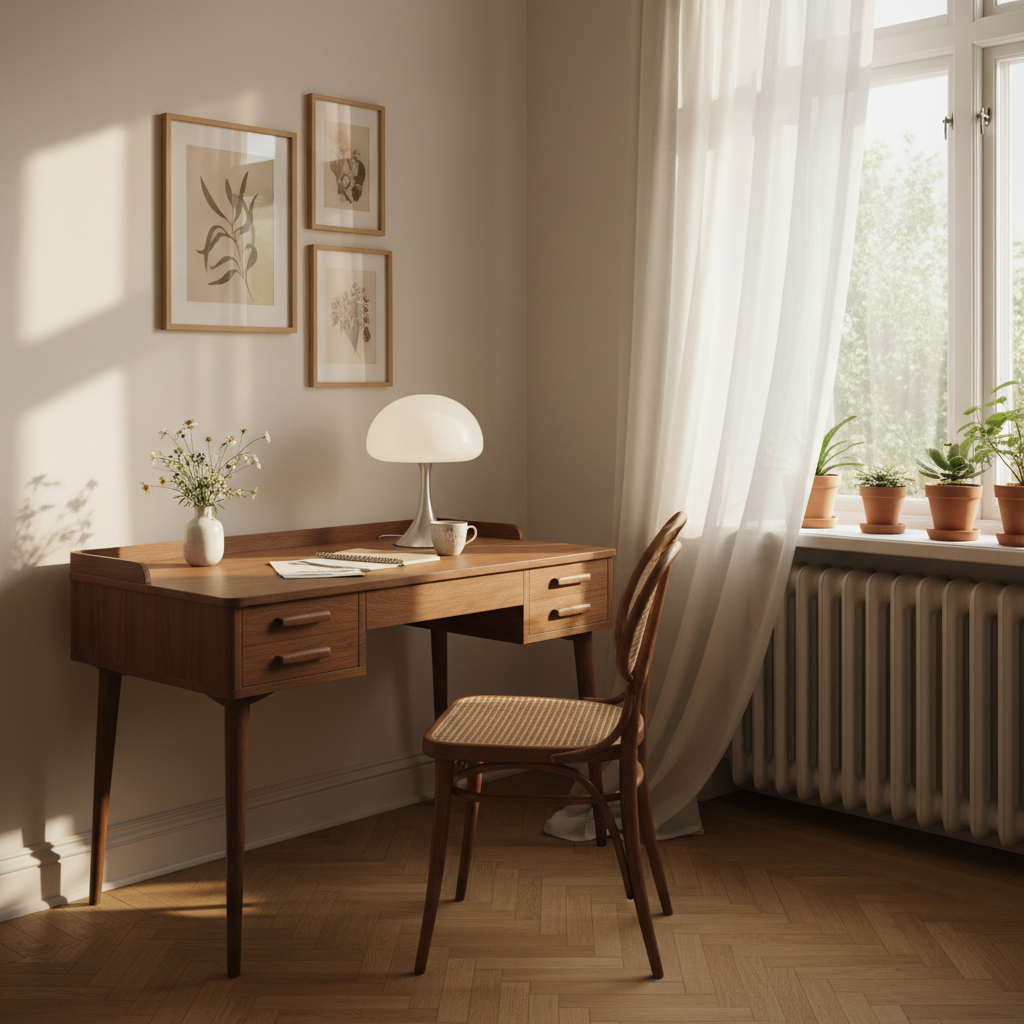
Today's homes increasingly call for flexible, well-thought-out solutions. Not everyone has a separate study, but almost everyone needs a place to work, write or be creative. This is exactly where a small wooden desk comes into its own: it takes up little space, yet it can make everyday tasks considerably more comfortable.
Designs inspired by the aesthetics of the 1950s and 1960s work particularly well. A mid-century desk combines compact dimensions with timeless design, so it becomes a natural part of the interior rather than just a functional add-on.
Mid-century style – ideal for small spaces
Mid-century modern style emerged at a time when designers had to create furniture suited to small homes and changing lifestyles. The priorities were functionality, lightness of form and making the most of limited space. That is why a mid-century desk also meets today's needs so well.
The style is characterised by:
- slender proportions and visual lightness,
- natural wood and veneer,
- gently splayed or turned legs,
- simple desktops without bulky add-on units.
These features mean that desks in this style never overwhelm a room and are easy to combine with other furniture, whatever the size of the space.
A small wooden desk – when every centimetre counts
A small wooden desk is designed with multi-purpose rooms in mind. It can serve as a workspace, but it works equally well as a dressing table, a console or a discreet writing corner in the living room or bedroom. Its compact form leaves you free to move around the room.
Natural wood means that a vintage desk never looks technical or office-like. Instead, it brings warmth and calm to the interior and becomes an integral part of the décor. This is especially important in spaces that serve several functions at once.
The mid-century desk – an aesthetic that supports concentration
A mid-century desk stands out not only for its looks but also for the atmosphere it creates. Simple forms and natural materials help to calm the space and encourage focus – which matters a great deal when working or studying at home.
These are often desks with one or two discreet drawers tucked under the top. This keeps things tidy and reduces the number of items on display, so the workspace feels more organised and inviting.


How to fit a small mid-century desk into your interior
For a small wooden desk in mid-century style to do its job properly, it is worth paying attention to its surroundings. Even a tiny work corner can be comfortable and attractive if it is well planned.
The key elements are:
- good task lighting that does not strain your eyes,
- a light chair in a matching style,
- keeping the number of items on the desktop to a minimum,
- a calm, natural colour palette around the desk.
This way, the desk becomes not just a functional piece of furniture but a place you are happy to return to.
A timeless choice for years to come
Both a small wooden desk and a mid-century desk are choices that do not follow passing fashions. They are pieces designed for durability, comfort and an aesthetic that does not date over time.
Their versatile character means they adapt easily to changing needs and interior layouts. It is an investment in quality, calm and functionality – values that never go out of date.
Summary – a small desk, a big change to your space
A small wooden desk in mid-century style is a solution perfectly suited to the needs of contemporary interiors. It combines compact dimensions with an aesthetic based on simplicity, natural materials and well-considered proportions. As a result, it not only makes working comfortable but also brings order and calm to the space.
A mid-century desk does not dominate the interior – it works in harmony with it. It can become a discreet place for work, creative projects or daily rituals while keeping its lightness and timeless character. It is a choice that stays relevant and adapts easily to a changing lifestyle.